
Lucky Mister Registration and Account Setup
 Available in GB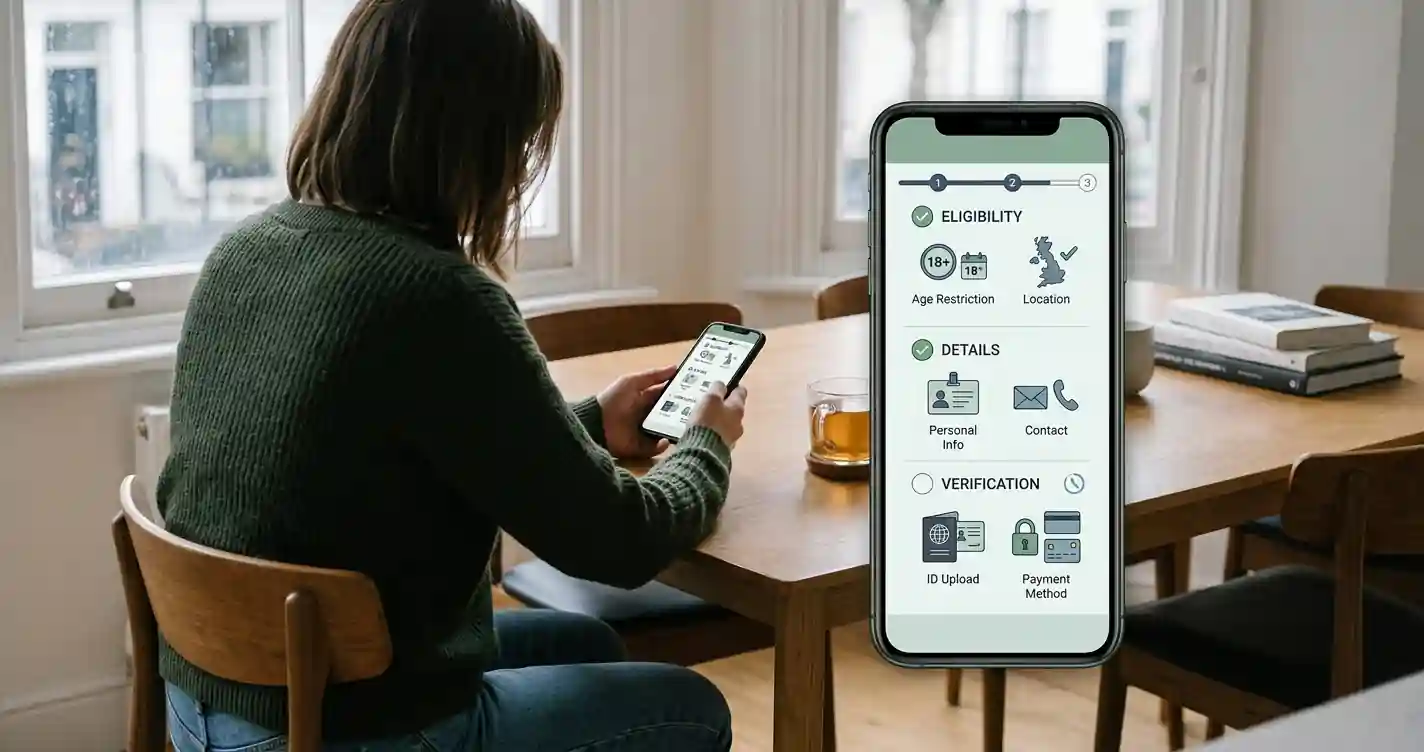
Content
Publicly available evidence supports UK-facing access and registration at Lucky Mister, while identity verification is also used around account checks and withdrawals. Exact registration fields and exact document requests are not stable enough to publish here as fixed requirements. UK readers should also keep a separate regulatory point in mind: evidence that a site can be accessed or an account can be opened is not the same as proof that the operator holds a UK Gambling Commission licence.
In Great Britain, online gambling is generally restricted to people aged 18 or over, and UKGC-licensed online operators must verify age and identity before gambling. Those rules explain the regulatory benchmark, but they do not by themselves establish Lucky Mister’s own UKGC status.
The registration process at a practical level
A sensible registration flow starts with opening the account page from the casino site, entering accurate personal details and choosing credentials you can secure. The exact form fields should be checked live because they can change and may depend on country selection or the operator’s current account workflow.
- Open the registration flow from the casino website rather than a copied third-party form.
- Use your real name, date of birth and current contact details.
- Choose the correct country and currency where the form gives those choices.
- Create a unique password and enable any security options the account makes available.
- Review the information before submitting it, because mismatched account details can complicate later verification.
- Expect identity checks before or during continued account use, especially around financial activity.
If you want a broader decision framework before opening an account, start with the Lucky Mister UK review.
Age and identity checks in the UK context
The UK Gambling Commission states that most gambling in Great Britain, including online gambling, is for people aged 18 or over. It also states that regulated online gambling businesses must verify a customer’s age and identity before gambling. That is an important benchmark for what UK players should expect from a regulated remote-gambling environment.
Available evidence confirms that KYC is used, particularly around withdrawals and account checks. It does not support a fixed list of documents for this page, so it would be misleading to promise that a passport, driving licence, bank statement or any other specific item will always be requested.
The detailed evidence boundary is covered on the Lucky Mister verification and KYC page, where document-level claims can be handled separately if current primary evidence is available.
Use details that can be verified later
Registration is the point where many future account checks begin. If a player shortens a legal name, uses an outdated address, mistypes a date of birth or registers with a payment method belonging to someone else, the mismatch can create friction later. Accurate details are therefore not just an administrative preference – they make subsequent account verification more straightforward.
| Account detail | Why accuracy matters |
|---|---|
| Name and date of birth | These are core identity fields and may be checked against verification evidence. |
| Address | An old or incomplete address can create avoidable discrepancies. |
| Email and phone | They may be used for account access, notices or security checks. |
| Payment ownership | Using payment details that match the account holder reduces obvious identity conflicts. |
Registration does not prove UKGC authorisation
This is one of the most important distinctions for UK readers. The ability to reach a registration page, select the United Kingdom, or create an account is evidence about access or account workflow. It is not a substitute for a UKGC register entry. The UKGC states that businesses providing remote gambling to consumers in Great Britain need the relevant operating licence.
Accordingly, readers should evaluate Lucky Mister’s registration process separately from the question of regulatory authorisation. The Lucky Mister safety and trust guide covers that broader distinction rather than burying it inside a sign-up tutorial.
Before making a first deposit
Do not treat successful registration as the end of the checks. Before depositing, confirm that the account details are correct, review the cashier shown to your own account and understand any verification prompt already visible. The available evidence supports card and crypto payment categories, but the live cashier is the better place to confirm what is available for a specific account.
The Lucky Mister payments guide explains those categories and the limits of the evidence. Exact withdrawal limits, processing times and fees are not treated as settled facts unless they are reverified from suitable current sources.
Security habits for a new account
- Use a password that is not reused on email, banking or other gambling accounts.
- Keep recovery details current so you do not lose access to verification messages.
- Do not send identity documents through unsolicited chat, social media or email links.
- Log out on shared devices and avoid saving payment details on a device you do not control.
- Save screen captures or confirmation messages for important account changes if the interface provides them.
These are general account-security practices rather than claims about a specific Lucky Mister feature set.
Pause before turning registration into a deposit
Finishing a sign-up form does not require an immediate transaction. Use the completed account to review the cashier, verification area and support access first. If anything important is unclear, resolve it before funding the account rather than using a deposit to discover how the process works.
Separate account setup from the decision to fund it
Opening an account and making a first deposit do not need to be one continuous decision. Once registration is complete, review the account details you entered, confirm that you can access the relevant account and cashier areas, and read any terms that affect eligibility or verification before adding funds. This creates a useful checkpoint where errors can be corrected before they become tied to a payment or later verification request.
The same pause is helpful for regulatory questions. Being able to reach or register on a site is evidence of access, not evidence of UKGC authorisation. Keep that distinction separate when deciding whether to proceed. Registration convenience, payment availability, verification requirements and licensing status answer different questions and should not be treated as interchangeable signals.
If any personal detail was entered incorrectly, deal with that before trying to work around it with a second account or a different payment identity. Consistent information across the player account and the payment route is easier to explain if verification is requested later, and it reduces avoidable uncertainty around ownership.
Use the first login as a verification checkpoint
After registration, sign out and back in once before making the account part of a regular routine. Confirm that the credentials work, that recovery options are understandable and that the account information shown to you matches what you entered. This is a simple way to catch a typo or access problem while the setup is still fresh, before it becomes connected to a later payment or verification issue.
Check eligibility before treating sign-up as approval
A registration form accepting your details is not the same as a final eligibility decision. Before funding the account, review any country, age and account-use conditions that are visible in the current registration flow or terms. If the form allows you to continue but the wording around eligibility is unclear, treat that as something to resolve before depositing rather than as confirmation that every UK user is accepted.
This distinction also keeps the regulatory question separate. A site can be technically accessible from the UK without that access proving a UK Gambling Commission licence. Registration tells you that an account-creation route exists; it does not answer which regulator, if any, authorises the operator for Great Britain. Use the dedicated trust and licence pages for that separate check.
Prepare details for later consistency checks
The most useful registration habit is consistency. Enter your real details carefully and keep them aligned with the information attached to the payment method you intend to use. Small discrepancies can become harder to explain later if verification is requested around a withdrawal or account review. Do not invent abbreviations, alternate spellings or contact details simply to move through the form faster.
After registration, save the information you genuinely need to manage the account: the login route, any confirmation message, and the current terms that matter to your planned use. Do not save passwords in an unsecured note or send identity information to yourself through an unprotected channel. The goal is to make later verification easier without creating a second privacy problem.
Related Lucky Mister guides
Lucky Mister UK review | Lucky Mister verification | Lucky Mister payments | is Lucky Mister safe
A cleaner way to prepare for registration
Use accurate personal details from the start and keep the same name format across the account and any payment method you expect to use. Before depositing, confirm that you can access the account settings, understand where verification requests would appear and know how to reach support. This reduces the chance that a simple mismatch becomes a larger problem when a withdrawal is requested later.
Why consistency across account and payment details matters
Registration is not only about opening the account. The details entered at this stage can later be compared with identity information and payment ownership. Consistent information makes those checks easier to follow, while nicknames, outdated addresses or third-party payment details can create avoidable questions. Correct obvious mistakes before making a transaction rather than waiting until a payout is pending.
What to save after opening the account
Keep the registration confirmation, note the email address used and retain records of important account changes. If you later contact support about verification or a payment, a clear timeline helps you explain what happened without relying on memory. Avoid storing passwords in plain text; use a secure password manager or another protected method instead.
Decide on limits before the first transaction
Set a budget before using the cashier and treat it as a spending limit rather than a target. The purpose of this step is to separate entertainment spending from money needed for bills or savings. Registration should be the point at which you decide whether the site fits your practical and regulatory comfort level, not an automatic reason to deposit.
What to confirm before opening a Lucky Mister account
For a UK reader, the best pre-registration check is simple: confirm that you meet the age requirement, use accurate personal information, understand that KYC can be required, inspect the live cashier before committing funds, and keep regulatory authorisation separate from mere site access. Exact form fields and document requests should be checked in the current account flow because the available evidence does not justify publishing them as fixed requirements.
Confirm the account details, payment ownership and verification route before committing money, so later checks are easier to understand and document.
This material was created by the Lucky Mister UK Guide team.
Related posts
Lucky Mister Player Feedback and Complaints

Lucky Mister Licence and UKGC Status